|
On some of the descents, the hill is steep enough that there are
lots of switchbacks.
On this one, I caught Brenda as she zoomed down the hill.
|

|
|
Pontferrada is just getting into the tourist business. Much of its
old town
is falling down, with an abandoned look. There is a large fort which
is being
rehabilitated. Some private buildings are now being fixed up as well.
This is the
balcony on our room
in our hotel there. The balcony has been added, the outside covered
with stucco the inside
with plaster, but the rooms still show some of the original stone
around the windows.
Here is Brenda trying out for the part of Juliet.
|

|
|
You can see some of the stone here, if Brent would just get away
from the computer for a
second. Oops, that's Brenda. Well, she will have to bring her own
computer next time.
The bathroom walls were all a very interesting yellow marble. The
faucet on the tub looked like a standard two handle faucet, but
rather than hot and cold handles, the left controlled the volume
and the right the temperature.
The room key was one of those electronic keys. It also served to
turn on the lights - until you pushed the key into a slot in the
wall you had no lights. If you left the room and took the key along
all the lights went out.
|

|
|
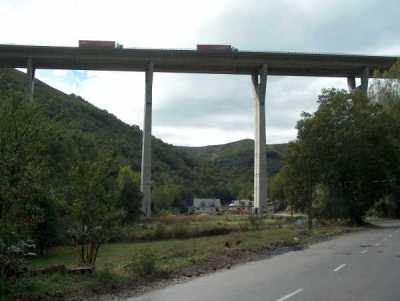
There is a rather large hill ahead of us - an ascent of about 700
metres, or 2300 feet. This is
how the expressway handles the hill - giant bridges that cross
small valleys. We saw several
of these bridges during this climb.
|
|
|
This is two hours later and we are still working our way up the
hill. The grade in this section
averages around 7.5%, with some parts steeper. We were able to cycle
up grades of 6%, but
soon found it was much
easier to push the bikes than to ride them with these steeper grades.
It had been raining pretty steadily for the
last hour or so when I took this picture. We have about one more
hour of this to go before we
reach the top.
This is not exactly what we had in mind. Pretty exhausting, but also
interesting that were were
able to actually finish this climb.
|

|
|
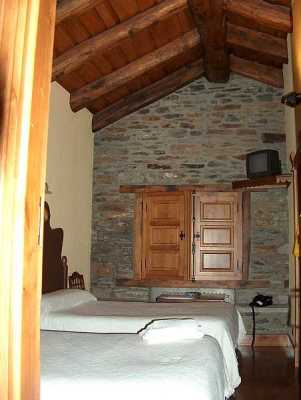
This was the room we found at the top of the hill - in the
hamlet called O Cebreiro.
Once again people are spending big money fixing up older buildings
to rent to the pilgrims
willing to spend more (make that quite a bit more) than the few
pennies they charge for the
basically free pilgrim
refuges called Albergues.
The doors in the far wall are actually shutters - they put the
shutters on the inside of the window
rather than the outside! So the sequence is: double pane windows on
the outside that open out, double pane
windows on the inside that open in, shutters on the inside of the
inside windows that open in. When
everything is shut, the room is very dark and very quiet. Pretty
good system.
|
|
|
Here is the building from the outside. The two upper windows on the
left
side at the front are
ours. Looks like an old building, but has a new slate roof. Perhaps
it is an instant old
building.
|

|
|
This is what the locals lived in before modernization - slate or
tile roofs came in the modern era.
|

|
This picture is a combination of 5 pictures, showing the valley we
cycled up today - looking west from O Cebreiro. It is
around 6pm and is finally sunny - after raining on us almost all day
while we cycled up
this mountain. Right now Brenda is soaking in the bathtub, trying to
warm up.
|
Its tomorrow already and the clouds and rain are back.
This is another Germany trekking group - their bicycles appear to
have all been brought to the top
of the hill and they are going to cycle down.
These are not your everyday mountain bicycle type folks - the bikes
are Mary Poppins bikes and the
people are Mary Poppins people. The bikes have soft seats, high
handle bars, and just one set of
gears. All the gearing is in the rear hub - not outside like on our
bikes. It appears to be an
improvement in the old 3 speed English bicycles of 30 years ago.
In spite of the simple appearance, their gear range appears
to be almost as wide as ours, even with our 3 front sprockets and 9
rear sprockets. It could be
we are due for a change in bicycle mechanisms over the next couple
of years.
This group of cyclists were all cycling in their ordinary clothes.
Most looked like retired school teachers or accountants, out for
a little cycle around the park.
There were about 30 of them, happily cycling down this mountain in
the rain. That's right, the
clear skies of last night let up and the rain is back for two or
three more days.
|

|
|
There was one other couple in the renovated building we stayed in at
the top of the mountain -
a Dutch/American couple who are currently
raising hothouse vegetables, in southern Spain, for export to the
U.S. We had dinner with them - a rather
rustic meal, with very cheap local wine but lots of food to refuel
us after a very
hard day. We learned a lot about Spain - from their point of view.
We would have learned something
very different from a Spanish couple. The truth is somewhere in
between, I expect.
They were starting their pilgrimage here - about 150 km from
Santiago. They say that
lots of people start here. The rules require that you walk at least
100 km so, I guess
it could have been worse!
She has a 5 kilogram pack and has planned this carefully. He is
Dutch, so "failure [to complete the
pilgrimage even without training hikes] is not an option".
|

|
|
The trips up and down these big hills have been hard on the bikes as
well as us.
This picture was taken at the end of a 1 hour session by this stream
washing the wheel rims and adjusting the
brakes.
Hours going downhill in the rain wears brake pads very quickly. Our
pads are almost worm out and our bikes are only
3 months old. As the pads wear, they coat the wheel rims with brake
pad dust, which seems to reduce the
effectiveness of the brakes. So, you have to squeeze harder and they
wear faster and so ...
I got some new pads but have not yet installed them.
This looks like a nice day but we were on the trail here, rather
than on the road, so we did a lot of pulling the
bikes up hill and carrying them downhill most of this day.
We were still tired from the big hill up to Cebreiro and the cold
wet day down, so we did not put on many miles
this day either.
|

|
|
A few things we saw in western Spain, the province of Galicia in
particular, were completely outside
our experience. For example, these weird plants. They look a lot like
cabbage, but who ever saw a 6 foot tall cabbage plant with just the
leaves. It appears the locals
pick the bottom leaves off the plants all summer long, forcing the
plants
to rise to great heights. An entire garden or over-achievers?
Normally I would not bother you with pictures of peoples' vegetable
gardens, but this is just too weird.
[The hotel we stayed in near Lisbon had two of these plants in large
clay pots at the front door. The concierge said the Portuguese name is
couva and they are used in soups.]
|

|
|
While we are on weird, this is a cartoon character they use to
represent pilgrims, usually pilgrims on
bicycles, also in Galicia. These cartoon characters offered hints as
to the difficulty of cycling the
road versus the trail for the last couple of days.
This metal sculpture is a fountain - you can see the spout
where the mouth should be. On hot days, it was
a real relief to find cool, fresh water along the trail. Most towns
have fountains where you can refresh your
water supply in the main square ("Playa Mayor").
|

|
|
We found these weird bottles in a restaurant near Portomarin. This
restaurant serves the thickest veal chops
on the planet. Fantastic.
I thought this was just a different way of serving olive oil. In
fact, it turns out it contains a very strong
form of alcohol - tastes a lot like 100 proof moonshine. The locals
have a shot of this in their coffee at
the end of their meal.
We are not locals. If we tried this we would be sleeping it off in a
ditch somewhere along the way.
|

|
|
Portomarin has had an interesting recent past. Someone decided they
need to flood the town as part of the
construction of a reservoir. They moved most of the old buildings up
the hill from the original location
down by the river, the flooded the entire valley.
This being the hottest, driest summer in 100 years, the reservoir has
been completely depleted, and the
old bridges and buildings are again visible.
This bridge looks like it is still in use to cross this river. In
normal times, this bridge is probably 100
feet under water. Looking at the edges of the picture, you can see
the normal level of the reservoir in this
area.
|

|
|
Here is another shot of the old river and its old banks, and the new
river/reservoir and its normal level.
|

|
|
The last few picture might have been a little deceptive - you might
think that the good weather has returned.
In fact, it has been raining on and off for the last 6 days.
We had just stopped cycling in Portomarin and were about the check
into a hotel when it really started to rain.
|

|
|
Here is another weird thing you see in Galicia but nowhere else -
this strange building raised off the ground,
with the churchy type symbols on top.
The first one I saw was behind a church, so I thought it was some
type of a tomb. However, they soon appeared
behind most every home in the country, and they were mostly decrepit
- no longer actually used. My next guess
was that they were being used to hang hams - these people are great
for cured pig legs.
Eventually I was able to ask a Portuguese (not an expert, but a
reasonable source) who said they were used to dry
fruits and vegetables - a way to preserve them over the winter.
They have become such a symbol of Galicia that even new homes have
them - smaller than this - even though they
never intend to actually use them!
|

|
|
In spite of the rain and the hills, we did complete the Camino de
Santiago!
Here we are posing in front of a scuplture on the hill outside our
destination - delaying our triumphant entry
into Santiago and titillating the eager crowds who will be waiting
beside the trail to toss rose petals under our tires as we
cycle up the hill to the cathedral.
I had 10 seconds to run the 200 feet from the camera to the
sculpture. The dumb camera though I was shooting a picture
of the grass, so focused at 8'. Otherwise you could have had a
better view of two very tired peregrinos.
|

|
|
So, here we are almost at the cathedral in Santiago - but where are
the crowds? Is no one reading the web pages?
Hard to believe. Perhaps we made a mistake cycling into town during
siesta?
|

|
|
Here is Brenda in a plaza at the back of the church - still no crowds.
They get all excited about someone stabbing a bull, but nothing for
people who have cycled their butts off for
15 days.
|

|
|
In spite of the big letdown at the completion of the trip - business
as usual (I feel so cheap) - I will include a few
pictures of what the pigrimage has built in Santiago.
Here is the front of the cathedral.
|

|
|
Lest you thing this is a spiritual place only, here is a closeup of
the central spire.
Looks like some early Guggenheim found a better way to spend his ill
gotten gains that a wrinkled building
and a buch of phoney art. "How about a statue of me?" Of course, it
could be a depiction of some saint or
other. Still, better than someone with a fish fetish spending all
that money on a museum - so there was none
left for art.
|

|
Looking the other way the next morning, you can see the real
business of Santiago. This is a composite of 5 pictures
take from the front steps of the cathedral looking out at the plaza.
It is 10am, early by Spanish standards, and the square is full of
tour groups. It's a little hard to tell how many right
now, but probably around 10. These groups started walking past our
hostel at about 9am. Most of the people appeared to
be Spanish speaking.
At a group every 2 minutes or so, each group around 30 people, we
have maybe 900 people an hour. Makes the pilgrim
thing, fewer than a 100 a day at this time of year, look like small
change. Of course, not even these big tour groups
get the rose petal treatment that I was sort of expecting. Sigh.
|
|

|
Ok, off the no reception thing for a moment, and back to weird
things about Spain - the evening
stroll.
I have mentioned it before - the fact that in the evening everyone
who has a baby in the family dresses up
and heads out for a stroll. The idea to to show off the new unit,
chat a bit, move on to the next friends/relations.
There are actually 4 in this picture with one faking it - the woman
in the red sweater dragging the stroller
behind her with her child
walking beside her has probably been outed by a real recent mother
and is heading home in disgrace.
Aside from this wannabe, the real mothers and fathers make a point
of heading out for a stroll in the evening with
their kids all togged out on display. This was common all across
northern Spain. On our first night out in the
city plaza in Portugal I was sort of expecting the same sort of
thing, but the stroll idea appears to not extend
beyond the Spanish border.
|

| |
As a parting shot of Santiago - ballet models! Looks at the waists
on those girls! The extension. The foot and hand
position. Brenda was trying to sign them up for the next recital.
|

| |
Since we had a plane to catch in Lisbon (and since no one appeared to
care one way or the other), we headed out
of Santiago south toward Portugal the next morning.
Along the way, we stopped for lunch at a truckers' cafe - the trucks
were lined up outside in very careful rows, perhaps a demonstration
of driving skill. Seeing people
at another table had ordered a paella, we thought that would make a
nice lunch so we pointed at it, waved off
all other offers and this arrived. Not bad we thought and set to
work on it. Brenda worked hard, but soon tired.
I continued on, but could not finish it.
About this time I noticed that the two truckers who had also ordered
the paella were now getting their real lunch -
a huge platter of barbequed ribs or chops or something.
Now, I know trucking is tough and all, what with having to sit
behind the wheel all day, but what makes these
guys so hungry?
The Spanish had a very neat idea for restaurants - the three course
meal, plus wine or water.
It is called the "menu de dia". You get to order one thing from the
first part, one from the second, and one from the
third. The first is usually soup or salad. The second is the meat
and potatoes. The third is desert. We half expected
that this idea would continue on into Portugal, but it did not.
|

| |
One thing about Spain and Portugal that is great for cycling
tourists is that they include this great laundry tub
in the bathroom in every hotel. I was able to let one bunch of
sweaty cycling clothes soak during dinner, then start
another set right away. The Europeans are so clever.
|

| |
We cycled a bit, then took a couple of buses, then ended up in
Leiria - a medium sized town about one-third of
the way to Lisbon from the Spain/Portugal boarder.
Across the road from our hotel this man was barbequing steaks and
fish in a metal barrel on the
sidewalk in front of his restaurant, so we headed in for dinner.
|

| |
Renato (on the left) and his wife Lena (pronounced n, not ny) help
us with the order, chatted with us
over dinner then joined us when their son (soon to be Phd in
Mathematics at the University of Coimbra)
and his girlfriend left.
Renato (and his brothers, one of whom is a twin) makes anything out
of plastic, but spends 30 hours a
week on the road visiting his customers in Spain and Portugal. Lena
is a lab tech - hospital lab type stuff.
They kept us up till 11 (very late for cycle tourists) then offered
to meet us again the next night in our
next town for dinner. They also planned our route through Portugal
for the next two days.
Not sure how I managed to get a picture of them not laughing - they
seemed to be laughing the whole time
we were with them! Could it be that people get very serious when
they know they will be on our web page? Fame
can make even the least serious people think for just a moment about
how they will appear to future generations.
|

| |
Renato sent us west from Leiria to the coast - a very small town he
said was the Monaco of Portugal - wealthy folks,
little of the commerical stuff. A very pretty town with a few great
cliffs and lots of sand.
Here are a few Portuguese men working hard at catching a few fish -
Brian Tobin need not be concerned, there is little
chance they are fishing off the nose (or whatever that little bit of
the Grand Banks is called that got him so upset).
|

| |
From there we cycled down the coast to the much more touristy town
of Nazare. This shot from the cliff north of town.
Nice spot, but very commercial. As soon as we stopped our bikes in
front of the tourist information we were approached
by someone with rooms to rent.
|

| |
They catch these little fish, gut them, slice them open, and dry
them on racks right on the beach. Here is a fresh set.
The woman tending these wanted us to go down to the other end where
the fully dried fish were.
|

| |
Here is another weird thing about western Spain and Portugal -
plantations
of eucalyptus all over the place. Renato says they have been doing
this
for 70 years. A lot of the smaller farms, non-economic as the number
of
non-farming jobs increases and salaries rise, could become eucalyptus
plantations over the next 10 years.
|

| |
This is a small town north of Lisbon - perhaps Alenquer. Pretty
scenic and
as nice as any small town in Spain. The church is much less
ornamented than
a church would be in Spain.
For our second last day cycling we had sun, a headwind most of the
day, and
lots of little hills but the traffic was not too bad. We drank 3
litres of water
each during the 5 hours we cycled.
After about 1050 kms cycled in the last 3 weeks, along routes hillier
than we
normally do, we are both without injury - no blisters even. Cycling
is much easier
on the feet than walking.
We are both ready though for a little time off the bikes. We will be
picking up
an RV in Johannesburg and heading out on safari in Kruger National
Park.
|

|
I was surprised at how different Portugal was from Spain, or at
least the
part of Spain along the Camino do Santiago.
There were lots of sidewalk cafes in the Spanish towns we visited,
while
in Portugal you really had to hunt around to find a restaurant.
The evening stroll is different as well - there are far more people
out on
the streets of the older parts of town in Spain than in Portugal.
As well, the middle aged (50s and 60s) Portuguese is a smaller person
than the middle aged
Spaniard. I noticed in Spain that there were few 30 and 40 year old
people. It appears
they have left the rural areas for better paying jobs in cities in
Spain and other
countries. I did not notice it to the same degree in Portugal.
The real money in both countries appears to be in furniture stores.
Often the
furniture stores are as big as the car dealerships. I guess all
those new appartments
need furniture.
The Portuguese are far more likely to know English than the Spanish. A
Portuguese, when asked if they speak English will admit to a little,
then will converse very well, with no trace of an accent. The Spanish
will have a very strong accent when speaking much less English.
In general, Spain is a little more expensive than Portugal, with the
bigger cities being more expensive than the small towns.
Back to the main Spain page this way
Back to the trip overview page this
way
|
